SAMPLE REPORT. Generated by the same pipeline as every report, for a fictional founder: stated Visionary, scored Closer. Your report is built from your 70 answers.
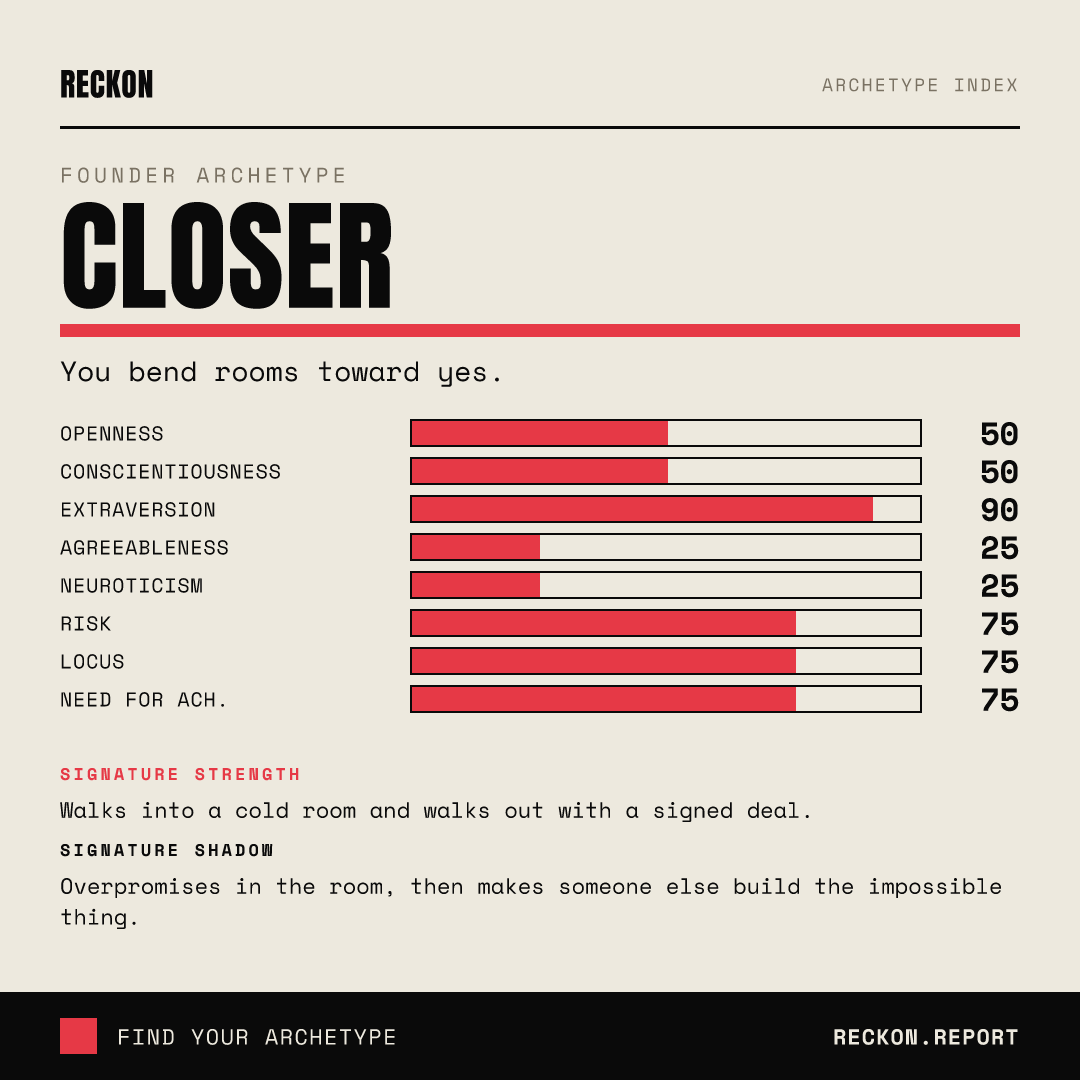
Closer.
DO THIS FIRST
Before you take any new client call this week, write down every open promise your team has not yet shipped and share that list with your cofounder.
Scorecard
Visual scorecard
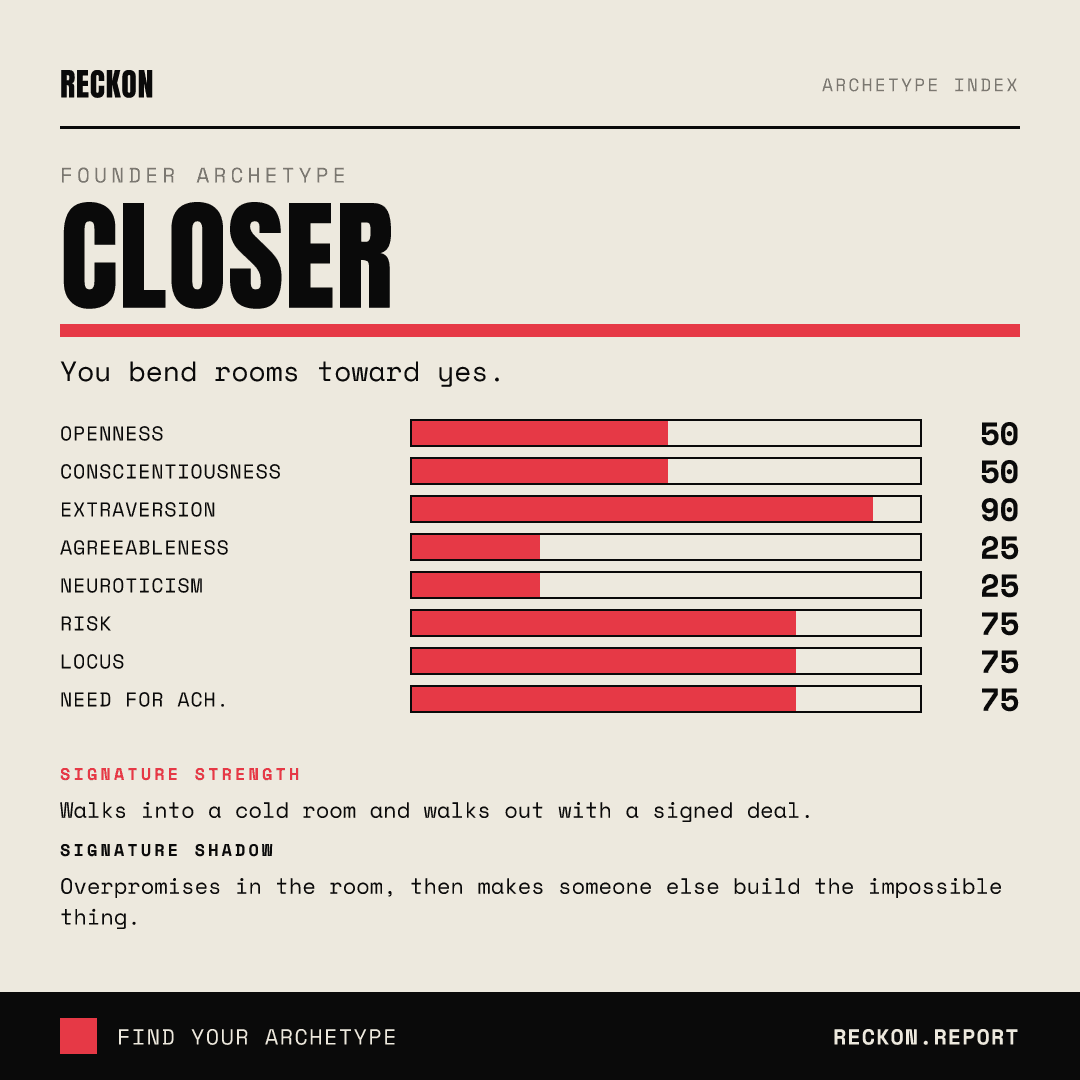
Your scorecard renders here, personalized to your answers.
Archetype comparison
How close you are to each type.
Your archetype is the best fit, not the only fit. This chart shows how much of each type shows up in your profile.
01Stated vs. measured
The hard truth.
You said Visionary. Your responses land on Closer, and the gap is one of the widest the assessment surfaces. A Visionary is pulled by an idea worth building. Your profile is pulled by the deal in front of you.
You are not losing focus. You are closing faster than your team can build, and calling the chase a vision.
Three dimensions carry this. Your Extraversion is high and your Risk Tolerance is high, so you move fast toward people and toward yes. Your Agreeableness is low, which means you push for the close without absorbing the friction it creates behind you. That is the Closer engine: win the room, book the commitment, keep moving. The Visionary story needs high Openness driving toward one durable thing. Yours is moderate, and your Conscientiousness is moderate, so the throughline and the follow-through are not what powers you.
Watch how this plays out in your own words. You keep signing new clients while delivery falls behind, and your cofounder says you promise what the team cannot build yet. That is not a focus problem. That is a Closer optimizing for the next signature while the room you already sold goes cold. The chase feels like vision. It is not. Before you take the next call, count the promises already on the board that nobody has shipped.
Based on your 70 responses · Scored July 1, 2026
Hit a nerve? Post it.
02Fatal flaw
The flaw that kills most people like you.
You chase the close before the idea has been tested, spending persuasion on concepts that haven't earned a buyer yet.
03Historical parallel
Ivar Kreuger: a case study.
Ivar Kreuger built the largest match empire the world had ever seen. A Swedish engineer turned financier, he spent the 1910s and 1920s assembling a network of match companies that at its peak controlled roughly two-thirds of global production. His real product was not matches. It was the deal: he lent money to cash-strapped governments in exchange for national match monopolies, financing the loans by selling securities to American investors who trusted the story. For a decade he was one of the most celebrated businessmen alive. In 1932 the story collapsed and he shot himself in a Paris apartment. The empire had been running on invented numbers.
Read your dimensions against his pattern. You scored high on Extraversion and high on Risk Tolerance, the exact engine that let Kreuger walk into a finance minister's office and leave with a monopoly. That is the Closer signature: you move people and you move on live capital without waiting for certainty. You also scored low on Agreeableness, which means you are comfortable making arrangements that serve your side of the table. Kreuger ran the same configuration. Your scores also show moderate Conscientiousness, and that is where the parallel gets pointed. Kreuger was a brilliant closer with weak internal bookkeeping discipline, and the gap between the deals he closed and the structure underneath them is what killed him. You said Visionary. Your responses say you close, and you close faster than you build.
Steal his access play. Kreuger understood that whoever controls the financing controls the terms, and your high Extraversion and high Risk Tolerance make you the person in the room who can actually secure that position. Put yourself where the capital and the commitments get decided, not where they get administered. That is your leverage; use it deliberately.
Now the part to avoid. Kreuger closed deals his own back office could not reconcile, and he covered the gap with fabrication rather than slowing down. Your moderate Conscientiousness paired with high Risk Tolerance points at the same exposure: you will keep saying yes while the operational trail thins out behind you. Do this instead. For every deal you close, name in writing the person and the ledger that has to hold it up before you sign, and refuse to advance until that structure exists. Stop treating reconciliation as someone else's job you will handle later. Kreuger treated it that way for fifteen years, and the day the numbers were finally checked, there was nothing behind them. Your high Need for Achievement will push you toward the next close; the discipline you have to install is closing fewer things you cannot account for.
04Dimension readout
Your eight dimensions.
Each dimension runs from very low to very high relative to other founders. Your archetype is the pattern across them, not any single trait.
Your moderate Openness fits the Closer profile your answers indicate. Closers are not ideators; they are executors who work the room. You engage with new ideas when they serve a deal or an angle, not for their own sake. The Visionary self-image runs on novelty as fuel. Your scores do not.
Moderate Conscientiousness also matches the Closer profile your responses point to. Closers keep enough structure to track the pipeline and follow through on commitments that matter, but they are not process-builders. You work from instinct and momentum more than from systems and checklists.
High Extraversion is where you align most clearly with the Closer profile your answers indicate. Closers are energized by people, pressure, and the live interaction. You are built for the room. This is the dimension where the Closer and the Visionary overlap, so it likely anchors the Visionary self-image, but Extraversion alone does not make the case.
Low Agreeableness is a core Closer marker, and your answers land there cleanly. You do not prioritize harmony when it gets in the way of the outcome you are after. You push, you press, and you are comfortable making the ask even when it creates friction. That is the Closer's edge.
Your moderate Neuroticism sits above the Closer ideal, which runs low. Closers do their best work when the pressure of the deal does not rattle them internally. You carry more internal noise than the profile calls for. It does not disqualify you from the work, but it costs you when stakes spike.
High Risk Tolerance fits the Closer profile your responses indicate. You are comfortable betting on yourself and moving before you have every variable locked down. Closers need this to make the call and commit. Your answers show you are wired to take the shot rather than wait for certainty.
High internal Locus of Control matches the Closer profile your answers point to. You locate responsibility for outcomes in your own actions, not in circumstances or other people. When a deal goes wrong, you look at what you did, not at what the market did. That orientation is what keeps Closers in motion.
High Need for Achievement also aligns with the Closer profile your answers indicate. You are driven to win, to hit the number, and to close. Where a Visionary's achievement drive points at building something new, a Closer's points at the scoreboard. Your responses describe the second shape, not the first.
05Business fit
Businesses you would build well.
- 01
Commission-based sales outsourcing for B2B SaaS
Your high Extraversion, high Risk Tolerance, and low Agreeableness fit a business where closing deals fast is the product and protecting margin means saying no to bad-fit clients without flinching.
- 02
Fractional revenue leadership for growth-stage startups
High Need for Achievement paired with high Locus of Control fits an embedded sales-leader model: you own the number, you move the levers, and exits come from the client's outcome, not just hours billed.
- 03
Performance-based recruiting agency for go-to-market roles
Your high Extraversion and low Agreeableness fit a contingency recruiting model where the fee is tied to the hire performing. You win by being right about people, not by being pleasant in the process.
- 04
Productized deal-flow advisory for niche acquirers
High Risk Tolerance and high Need for Achievement fit a structured advisory business where you source and qualify acquisition targets on retainer. The work is relationship-driven and high-stakes, which plays to your Closer profile.
- 05
Channel partnership brokerage for vertical SaaS vendors
Your high Extraversion and moderate Openness fit a brokerage model: you match software vendors to distribution partners and earn on the deal. Delivery is the partner's problem; your constraint is pipeline, which you generate well.
06Avoid
Businesses that will destroy you.
- 01
Productized service firm with standardized delivery SLAs
Your high Need for Achievement and low Agreeableness will push you to keep closing, but your moderate Conscientiousness means you will not build the delivery infrastructure. Clients churn when the product you sold doesn't match what ships.
- 02
Retainer-based creative or content agency
Retainer clients pay for predictable, repeatable output. You will oversell scope on every renewal because the close is the reward. Your moderate Conscientiousness means the tracking systems that prevent scope bleed never get built.
- 03
Technical co-development or software outsourcing shop
You already promise deliverables the team cannot build yet. In a technical outsourcing context, that pattern becomes contractual liability. High Risk Tolerance accelerates the commitments; moderate Conscientiousness prevents the project controls that would catch the gap before it becomes a client dispute.
- 04
Partnership-dependent professional services firm (e.g., joint-venture consulting)
Low Agreeableness in a structure that requires sustained co-investment and trust with peer partners means small frictions compound fast. You will win the room and then lose the relationship when the deal terms stop feeling like a win.
- 05
Subscription SaaS with a high-touch onboarding model
High Extraversion and high Need for Achievement will fill the funnel. Moderate Conscientiousness means onboarding never gets systematized. Churn outpaces acquisition once the pipeline you closed exceeds what the team can actually onboard and retain.
07Blind spots
Blind spots you keep stepping in.
- 01
Your high Need for Achievement and high Risk Tolerance push you to close the next deal before the current one is delivered. You don't see the commitment gap forming because the win feels like progress.
The fix
Before signing any new client, write down the three delivery milestones still open on existing accounts. If any are overdue, the new signature waits.
- 02
Low Agreeableness means you discount your cofounder's delivery warnings as friction rather than data. You treat pushback on scope as a confidence problem, not a capacity signal.
The fix
After every sales call, send your cofounder a one-line scope summary and require a yes/no sign-off before you communicate timelines to the client.
- 03
Your high Extraversion drives you to sell the vision of what you could build, but moderate Conscientiousness means you don't track whether what you promised maps to what your team can actually execute.
The fix
Keep a live promises log: every client commitment with a delivery date and owner. Review it with your cofounder weekly, not after the client follows up.
- 04
High internal Locus of Control makes you confident your charm and hustle can close the gap between what you promised and what ships. This hides the structural delivery deficit until it becomes a churn event.
The fix
Once a month, audit one recently closed client against the original scope you sold. Mark every delta. That number is your real sales risk, not your pipeline.
08Strengths + Friction
What you do well. What costs you.
Strengths
Room-reading and momentum control
You read the energy in a sales conversation faster than most and shift your approach in real time. When a prospect goes cold, you find the angle that re-engages them before they exit. That skill compounds in early-stage services work where the deal dies if you hesitate.
Pressure tolerance on the close
You don't flinch when a prospect stalls or pushes back on price. High Risk Tolerance combined with high Extraversion means you stay in the room and press while others back off. In a bootstrapped agency where revenue is survival, that composure wins contracts competitors talk themselves out of.
Direct challenge without apology
Low Agreeableness means you tell a client when their brief is wrong or their timeline is unrealistic, without softening it into uselessness. That directness builds credibility with clients who have been burned by agencies that just nod along, and it positions you as a partner rather than a vendor.
Friction
Scope creep at the point of sale
You add features, deliverables, and timelines to the proposal in real time to hold the client's attention. Moderate Conscientiousness means you don't audit what you just committed before the call ends. Your team inherits the gap between what was said and what was scoped.
Victory declared before delivery lands
Signing a client registers in your head as the win, so your attention moves to the next prospect before the current engagement is stable. In a 2-to-5-person shop, that attention pull means your cofounder absorbs the operational weight of every deal you celebrate and then leave behind.
Dismissing capacity as pessimism
When someone on your team says the timeline won't hold, your high internal Locus of Control and high Need for Achievement read that as a motivation problem rather than a math problem. You push through the objection instead of adjusting the commitment, and the delivery deficit compounds quietly until a client notices first.
09Cofounder
Who to build with. Who to avoid.
Your cofounder needs to be the ceiling on your commitments, not a cheerleader for them. You score high on Extraversion, high Risk Tolerance, and low Agreeableness, which means you close fast and push hard. What you need beside you is a Craftsman or Operator: someone with very high Conscientiousness who tracks what is actually buildable, owns the delivery timeline, and says no to your next pitch before it ships.
Another Closer or a Hustler accelerates the exact problem you already have. Your cofounder is already signaling that delivery is falling behind your promises. Add a second high-Extraversion, high-Risk-Tolerance partner and you double the pipeline pressure with no one adding capacity or discipline. Two people selling into a team that cannot keep up is not a partnership, it is a liability.
- 01They sit through your client pitch and never flag a single scope or timeline concern afterward.
- 02They talk about scaling the business but cannot tell you how the current four clients get delivered next month.
- 03When you describe the gap between what you are promising and what the team is shipping, they reframe it as a hiring problem rather than a commitment problem.
1030-day playbook
Your next 30 days.
This playbook is built for a Closer running a bootstrapped services business with a delivery crisis already in motion. Four weeks, one problem: your closing engine is outrunning your build capacity, and this plan addresses that gap directly.
W1Map the promise-to-delivery gap
Build a commitment inventory
List every deliverable you have promised to every current client. Next to each one, write whether it has shipped, is in progress, or has not started. Your high Extraversion and high Risk Tolerance mean you accumulate commitments fast without tracking them. This exercise forces the gap into plain sight before it becomes a churn event.
Get your cofounder's delivery ceiling in writing
Ask your cofounder to write down, in one document, what the team can realistically ship in the next 30 days. Not the ceiling you imagine, the one they are operating inside. Your high internal Locus of Control makes you confident you can close the gap between promise and delivery through hustle. You need to see the actual number before you book another call.
Pause net-new client outreach for seven days
No new pitches, no new proposals, no new calls this week. Your high Need for Achievement will make this uncomfortable. That discomfort is the point. You are stress-testing whether your closing instinct is running on signal or on habit.
W2Build a scope gate before every close
Write a one-page pre-commitment checklist
Before you make any promise to a prospect or client, you must answer three questions in writing: What exactly are we committing to ship? By when? Does the team have capacity confirmed? Your moderate Conscientiousness means you do not naturally build this kind of gate. Build it once, use it every time.
Route every new scope item through your cofounder first
For this week only, before you confirm any deliverable verbally or in writing, get your cofounder's sign-off in a Slack message or email. This is a controlled experiment in treating their input as a capacity signal rather than friction. Your low Agreeableness will resist this. Track whether it changes what you commit to.
W3Sell what you have already built
Identify one current client who could expand scope on delivered work
Your Hustler tension means you are pulled toward new opportunities and new relationships. The Closer underneath that wants a new win. This week, direct that energy at a client who already trusts you and where you have already shipped something. Expansion revenue from a delivered engagement does not add to the promise gap. It proves the model.
Rewrite your pitch to lead with what has shipped
Pull out the pitch or deck you use for new clients. Find every place where you describe what you will build. Replace those with what you have already built and delivered. Your high Extraversion and high Risk Tolerance make you naturally compelling when you talk about the future. Test whether you are just as compelling when you talk about the past. The past does not create delivery debt.
Have one direct conversation with each current client about timeline
Contact every active client this week, not to upsell, just to confirm their current delivery timeline is still accurate. Your moderate Conscientiousness means you have likely not done this recently. Some of these conversations will be uncomfortable. Run them anyway. Catching a client who is quietly unhappy costs less than losing them.
W4Install a permanent close-to-capacity rule
Set a hard client cap tied to team capacity
With your cofounder, define the maximum number of active client engagements your team can run at your current headcount without delivery slipping. Write the number down and treat it as a constraint, not a suggestion. Your high Risk Tolerance will push you to treat the cap as negotiable under pressure. That is exactly when it must hold.
Define your close criteria in one sentence
Write a single sentence that describes the condition under which you are allowed to sign a new client: for example, 'We sign a new client only when we have confirmed delivery capacity for their scope before the contract is sent.' Your Closer engine needs a gate, not a personality change. The sentence is the gate. Review it before every close from this point forward.
11Communication playbook
Where your type breaks down in conversation.
Four scenarios you will face repeatedly. Each one has a different failure mode for your type.
Giving feedback
You soften feedback because you read the room and instinctively protect the relationship. The risk is that the person walks away feeling fine but unchanged. Deliver the hard sentence first, then rebuild the relationship after.
Receiving criticism
You process criticism through the lens of the relationship: 'Do they still trust me?' That can distort the actual feedback. Before you assess the relationship damage, write down the specific behavior they flagged. Address the behavior; the relationship will follow.
Negotiating
You are a natural negotiator. You read what the other party wants and find creative deals. Your risk is agreeing to terms you cannot deliver because the deal felt too good to walk away from. Know your hard limit before you sit down. When the offer exceeds your limit, the answer is yes. When it does not, the answer is no. Do not negotiate that line at the table.
Asking for what you want
You ask indirectly by making the other person feel like it was their idea. This works in sales but erodes trust in personal relationships and with your team. Practice the direct ask. People respect Closers more when they drop the technique.
12Conflict triggers
Where you create friction.
These are the specific operational situations where your wiring produces conflict with cofounders and team. If you have operated with a team, you have likely met these already.
You commit to a delivery date in a sales call without confirming it with the product or engineering lead first. The team finds out from the customer.
FixSend a one-line internal message before committing any delivery date in a live deal, even if the answer takes an hour.
A team member escalates that a feature you sold does not exist yet. You treat it as a scope management problem and ask them to figure it out. They stop flagging gaps.
FixOwn the gap explicitly with the team before you own it with the customer; the internal conversation has to come first.
Your cofounder pushes back on a deal because the terms are bad for the company. You close it anyway and present it as already done. They lose trust in the process.
FixGive your cofounder a defined window to veto any deal above a set contract value before it is signed.
13Situational patterns
How you show up under pressure.
Three operational scenarios. How this archetype wiring produces behavior in each one.
In a high-stakes meeting
Very high Extraversion and high Risk Tolerance mean this profile is built for investor pitches and critical negotiations. You read the room in real time, adjust your frame on the fly, and find the emotional lever that moves the decision. Low Agreeableness means you do not soften the ask or accept a non-answer; you press until you have a yes, a no, or an actionable next step.
When a deadline is missed
Moderate Conscientiousness means the Closer did not spend much time on the project plan to begin with, so the miss registers as an execution problem that belongs to someone else. High Extraversion means you get on the phone with the customer or stakeholder immediately and sell the recovery narrative before the dust settles. The gap between your handshake and the delivery behind it is where you lose trust over time.
In a crisis
A key customer churning or a key hire leaving is a relationship problem, and relationship problems are where the Closer operates best. Very high Extraversion and an internal Locus of Control mean you are on the phone within the hour, listening aggressively, and rebuilding the connection. What does not happen is a structural fix; you win back the relationship without diagnosing why it broke.
14Conversation guide
The conversation you need to have before you start.
Start with what you do well. Say the risky thing before your cofounder finds it. Ask the question that prevents the fight you have not had yet.
The descriptions below reflect the typical pattern for your archetype. Your actual dimension scores may sit higher or lower.
Lead with
- 01
I close deals. Not eventually. I move the conversation to a decision and I get a yes or a next step before I leave the room. That is a specific and rare skill.
- 02
I make people want to be part of what we are building before they fully understand the product. That is not charm. It is a specific skill, and it converts.
- 03
I read people fast. I know when a relationship is real versus polite, when a buyer is ready versus stalling, and when a conversation is worth continuing.
Surface proactively
- 01
I close things that are not fully ready to be delivered. My drive to get the yes can outrun what the product or team can actually support. That gap is a real liability.
- 02
In conflict I push to win the argument rather than reach the right answer, and I do not soften it on the way. I can damage relationships I need long-term.
- 03
After the deal is done, my attention drops sharply. Retention, follow-through, and the operational detail that makes customers stay are not where my energy naturally goes.
Ask your partner
- 01
Before I commit a timeline or scope to a prospect, what do you need me to check with you so we are not signing up for something we cannot deliver?
- 02
When I am in argument mode and pushing too hard, what is the phrase you want to use that will actually make me stop and listen?
- 03
What does the handoff from closed deal to delivery need to look like so nothing falls through after I move to the next prospect?
15Misreads
What people get wrong about you.
Four things people consistently get wrong about this type. What they observe, and what is actually happening.
They think your confidence in social settings means you are shallow or not doing the analytical work.
Closers typically run very high Extraversion and an internal Locus of Control. The social fluency is a tool, not a substitute for preparation. You prepare because you believe the close depends on what you do in the room. The pattern recognition comes from years of running these conversations. The analysis happens faster than other people can see it.
They assume you are a pushover because you are charming and agreeable in the room.
Closers typically run very low Agreeableness. The warmth in the room is tactical, not dispositional. You are not agreeable by nature; you are socially skilled by practice. When the deal requires a hard line, you draw it without discomfort. People confuse social ease with conflict avoidance.
They see your momentum and assume the details will handle themselves once you have the handshake.
Closers typically run moderate Conscientiousness. The gap between handshake and delivery is not imagined. Post-close execution requires a discipline level that does not come naturally to your profile. The enthusiasm is genuine. The follow-through system does not exist by default. It has to be constructed on purpose.
They think your comfort with rejection means you do not take the work seriously.
Closers typically run low Neuroticism and high Risk Tolerance. Low emotional reactivity to rejection is a functional advantage, not a sign of low stakes. You take the outcome seriously; you simply do not catastrophize the setbacks. That is an emotional regulation profile, not an indifference profile.
16Reading list
Go deeper.
Hand-picked for your archetype. Each one connects to something in your profile.
Never Split the Difference
Chris Voss
Voss reframes negotiation as a listening discipline, not a pressure game. Your instinct is to drive toward yes; this book teaches you that calibrated questions and tactical empathy surface what the counterpart actually needs, which is where the real close lives.
SPIN Selling
Neil Rackham
Built on 35,000 real sales calls, Rackham's data shows that high-value closes come from asking Implication and Need-Payoff questions, not from closing techniques. The buyer who talks their way to the answer closes themselves. This is the empirical counter-argument to your natural instinct to steer.
Pitch Anything
Oren Klaff
Klaff's frame-control model maps almost exactly to how natural Closers operate without knowing it. Reading the neurofinance behind status frames and prizing gives you a repeatable architecture for pitches instead of relying on feel alone.
The Mom Test
Rob Fitzpatrick
Your natural sales instinct distorts customer feedback: people tell you what you want to hear because you are good at making them comfortable. Fitzpatrick teaches you to listen past that by asking questions even your mom cannot lie about.
Thinking in Bets
Annie Duke
Your blind spot is confusing a good outcome with a good decision, which leads to overconfidence in tactics that got lucky once. Duke teaches you to evaluate decisions by the quality of your reasoning at the time, not by what happened afterward.
17Podcast list
Keep listening.
Podcasts picked for your archetype. Each one connects to your strengths or growth edges.
Negotiate Anything
ListenKwame Christian
Start here: Harvard's William Ury: The Hidden Power of Going to the Balcony
Christian's archive is entirely about the mechanics of negotiation under emotional load. This episode with William Ury forces the listener to slow down and examine the instinct to close before the real stakes surface. Your blind spot is missing what the other side is not saying because you have already made them comfortable.
The Jordan Harbinger Show
ListenJordan Harbinger
Start here: 507: Robert Cialdini | A New Look at the Science of Influence
Harbinger built his career on the same toolkit you run by instinct: social calibration, rapport, reading a room in seconds. The Cialdini episode maps the cognitive levers that make people say yes, giving you the framework that explains what you already do by feel.
My First Million
ListenSam Parr and Shaan Puri
Start here: Shaan's Masterclass: How To Sell A Business For Millions
The masterclass episode puts the entire arc of a high-stakes transaction on the table: framing, timing, positioning, and where sellers leave money because they moved too fast. You need a sparring partner who thinks in deals, and this show is the closest thing to two founders who live in that mode.
Revisionist History
ListenMalcolm Gladwell
Start here: The Foot Soldier of Birmingham
Gladwell investigates an iconic civil rights photograph whose subject was not who everyone assumed. The episode is about the dangerous gap between what a story appears to say and what actually happened. For a Closer, it maps directly to your growth edge: projecting the narrative you expect onto people instead of hearing what is actually in front of you.
People Who Read People
ListenZachary Elwood
Start here: Some Useful and Reliable Poker Tells
Elwood comes from poker, where reading micro-signals under pressure is how you survive. The show interviews jury consultants, interrogation professionals, and deception researchers about decoding behavior in real time. This is an unexpected angle on reading people that goes deeper than most communication coaching.
19Mental models
Thinking tools.
Three frameworks matched to your archetype. Each one is a tool you can deploy immediately.
Sandler Pain Funnel
David Sandler, Sandler Selling System (1967)
A structured sequence of open-ended questions moving from surface problems to business impact to personal emotional stakes.
When a prospect says they have a problem but shows no urgency. Walk them down the funnel until the cost of inaction becomes concrete and felt.
They say 'we need better reporting.' You ask: 'What happens when the board asks for numbers you don't have?' Now it's personal.
Steel Manning
Philosophy and rhetoric tradition
Construct the strongest possible version of the other side's argument before responding. The opposite of a straw man.
When you feel certain you're right and the other person is wrong. Pause. Restate their position so well they say 'yes, exactly.' Then respond.
Your cofounder resists a pivot. Instead of persuading harder, articulate the strongest case for staying the course. You will either find merit in it or earn the trust to redirect.
Reciprocity
Robert Cialdini, Influence (1984)
People feel obligated to return value when they've received it first. Giving before asking creates social debt that drives action.
When you want something from someone and your instinct is to ask directly. Lead with genuine value instead. The ask becomes easy after the gift.
Before pitching a partnership, send them a warm intro to someone they need. When you ask for the deal a week later, they're already leaning yes.
20People to follow
Follow the signal.
Ten accounts picked for your archetype. Each one posts content that connects to your pattern.
Chris Voss
@fbinegotiator on X
Former FBI lead hostage negotiator posting tactical frameworks daily: labeling emotions, calibrated questions, using 'no' as a tool. Constantly frames listening not as politeness but as intelligence gathering, which reframes your natural sales drive as a discipline problem.
Annie Duke
@AnnieDuke on X
Former World Series of Poker champion and decision science author. Posts on separating decision quality from outcome quality, directly countering the Closer's occupational hazard of confusing a closed deal with a good decision. The sharpest antidote to persuasion-instinct overconfidence.
Wes Kao
@wes_kao on X
Co-founder of Maven posting dense threads on executive communication and making requests land. Adds the missing layer for Closers: how to structure influence in writing, in async contexts, and inside organizations where the listener has their own agenda to protect.
Daniel H. Pink
@DanielPink on X
Author of To Sell Is Human. Anchors selling in behavioral science rather than pressure tactics. His steady feed of peer-reviewed findings on motivation and influence goes deeper than the typical sales canon. The attunement concept is directly useful for hearing past your own persuasion frame.
Nikita Bier
@nikitabier on X
Built tbh (acquired by Facebook) and Gas (acquired by Discord). Posts about how products get adopted at scale: viral loops, emotional hooks, and why users spread things. Persuasion architecture at the systems level, not one deal at a time but designing the close into the product itself.
21YouTube channels
Keep watching.
Channels picked for your archetype. Each one connects to your strengths or growth edges.
Jeremy Miner
Watch on YouTubeJeremy Miner
Start here: 12-Minute Masterclass on Preventing Objections to Increase Close Rate
Miner's NEPQ method is neuroscience-grounded: instead of pushing past resistance, you use questioning to make the prospect surface their own urgency. This is the precise correction for selling through objections without processing them.
Science of People
Watch on YouTubeVanessa Van Edwards
Start here: Practise your first 10 words
Van Edwards translates behavioral science into practical communication tools. For a Closer whose strength is reading rooms, her body language frameworks add precision to what you currently do by instinct. The science helps you see when you are projecting confidence versus when the room is genuinely with you.
Oren Klaff
Watch on YouTubeOren Klaff
Start here: From Nobody to Closing $2 Billion in Deals
Klaff's frame-control method argues that trying to close too hard loses the frame and kills the deal. A Closer who studies Klaff learns to distinguish between situations where pressure accelerates a decision and situations where it triggers reactance. Smaller channel, higher signal.
Jubilee
Watch on YouTubeJason Y. Lee
Start here: Rich Men vs Poor Men | Middle Ground
Jubilee's Middle Ground format puts people with opposing beliefs in a room and asks them to find common ground. One of the best case studies in real-time persuasion, resistance, and position-shifting. Study how people actually change their minds under social pressure versus how they dig in.
Stanford Graduate School of Business
Watch on YouTubeStanford GSB
Start here: Negotiation and Influence | Stanford GSB
Stanford GSB's library includes negotiation lectures from faculty who study the science of influence at an academic level. For a Closer, this is the outside-genre pick: institutional research on how deals are structured, why anchoring works, and what happens to trust when pressure tactics are used. Rigor applied to the thing you already do by feel.
22Continue the conversation
Your report is a starting point, not an endpoint.
Paste your full report into ChatGPT, Claude, or your AI assistant of choice. Then use these prompts to turn a one-time snapshot into an ongoing conversation about how you operate. Each prompt is pre-loaded with your archetype and profile data.
I took a founder personality assessment and was typed as a "Closer." Here is my full report. Talk to me about my profile. Ask me 5 clarifying questions before giving advice.
Here's a specific decision I'm wrestling with: describe it here. Given my archetype as a Closer and my profile, walk me through how I should think about it.
Help me write feedback to my cofounder/manager based on what my profile says about how I handle conflict. My profile shows high Need for Achievement and moderate Neuroticism.
Help me prepare for my next quarterly review. What patterns from my profile should I be honest about? I'm a Closer with high Need for Achievement and high Extraversion.
Critique this plan I've drafted: [I'll paste]. Use my profile to flag the specific risks I'm likely to underweight given my Closer pattern.
Help me negotiate this offer: [I'll paste]. What should I push on given that my Agreeableness reads low?
I'm hiring for [role]. Given my profile as a Closer, what should I look for in a complement?
Roleplay as my coach for 20 minutes. Stay in character. Use my profile to push me. My archetype is Closer, my tension archetype is Hustler.
SEND THIS TO SOMEONE WHO NEEDS IT.
Your turn
This was a fictional founder. Your report is built from your 70 answers.
TAKE THE ASSESSMENT →Send this assessment to your cofounder
This report stays at this URL forever. Share the URL, screenshot the scorecard, or revisit anytime.
Reckon is not a clinical instrument. The report describes patterns in your responses. It does not predict outcomes or substitute for professional advice.
Report metadata
- Assessment ID
- 00000000-0000-4000-8000-000000000000
- Created
- 2026-07-01 00:00:00 UTC
- Scoring version
- 1.0
- Calibration status
- placeholder
- Calibration version
- sample
- Bank version at calibration
- 1.2.0
- Renderer mode
- verbal_descriptor
- Launch phase
- free_launch
SAMPLE REPORT. Generated by the same pipeline as every report, for a fictional founder: stated Visionary, scored Closer. Your report is built from your 70 answers.